
Best Color Palettes for Beachfront Villas in Jumeirah
Choosing the right color palettes for beachfront villas in Jumeirah can make a major difference to the way a home looks and feels. A villa close to the sea receives strong natural light, has expansive views and often benefits from a seamless connection between indoor and outdoor spaces. The colors you choose should work with all of these elements rather than competing with them.
For a beachfront property, the goal is not simply to make the interior look “coastal.” A modern Jumeirah villa can feel sophisticated, warm and luxurious without using obvious beach-themed colors or decorations. Soft whites, warm beige, sandy tones, natural wood, muted greens and carefully selected blues can create a relaxed interior while maintaining a high-end appearance.
Color should also be considered together with flooring, lighting, furniture, wall finishes and the architecture of the villa. A color that looks attractive on a small sample may look completely different when it covers a large wall under Dubai’s strong daylight.
If you are planning a renovation, these are some of the best color palette ideas to consider for a modern beachfront villa in Jumeirah.
1. Warm White, Sand and Beige
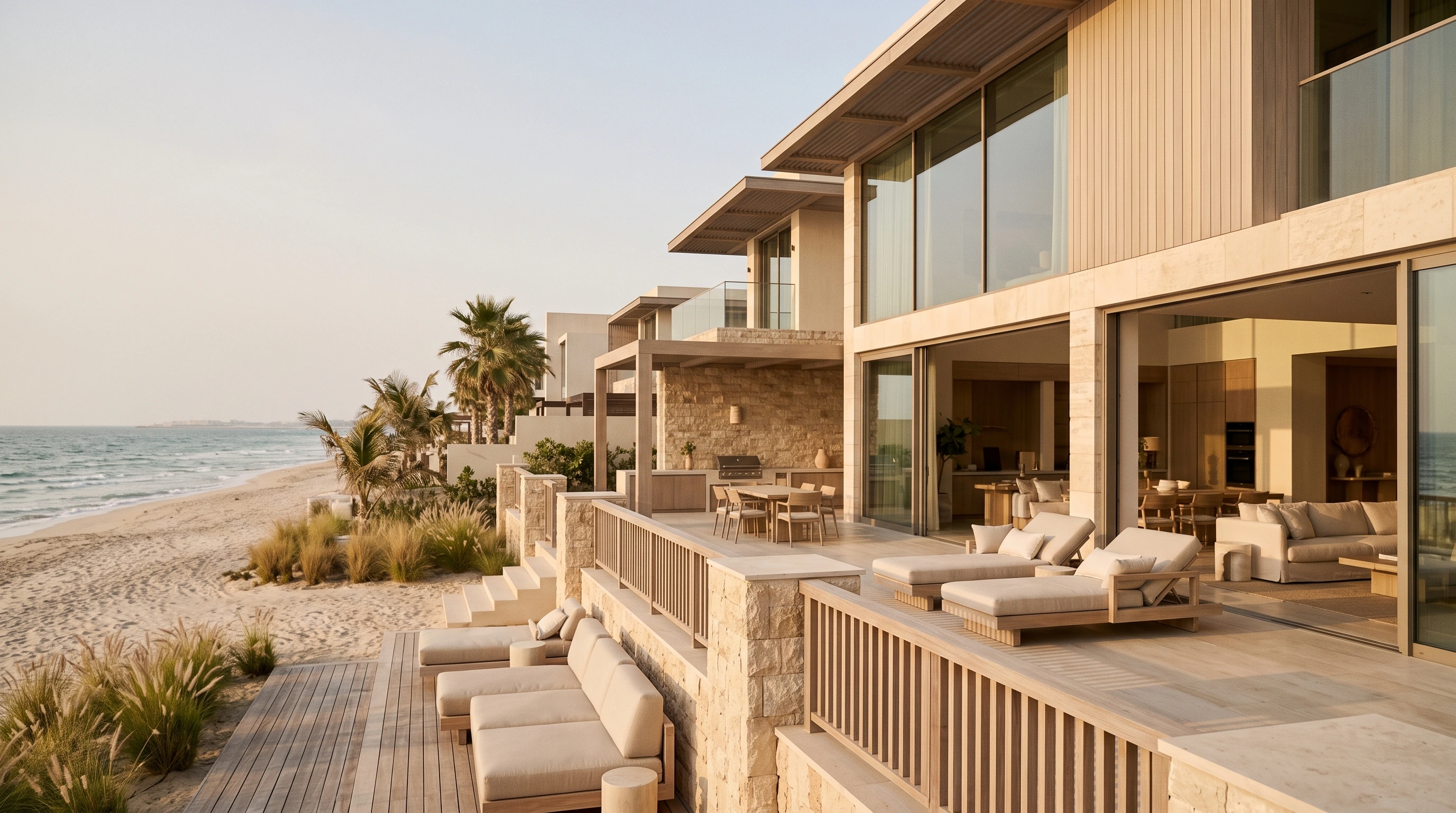
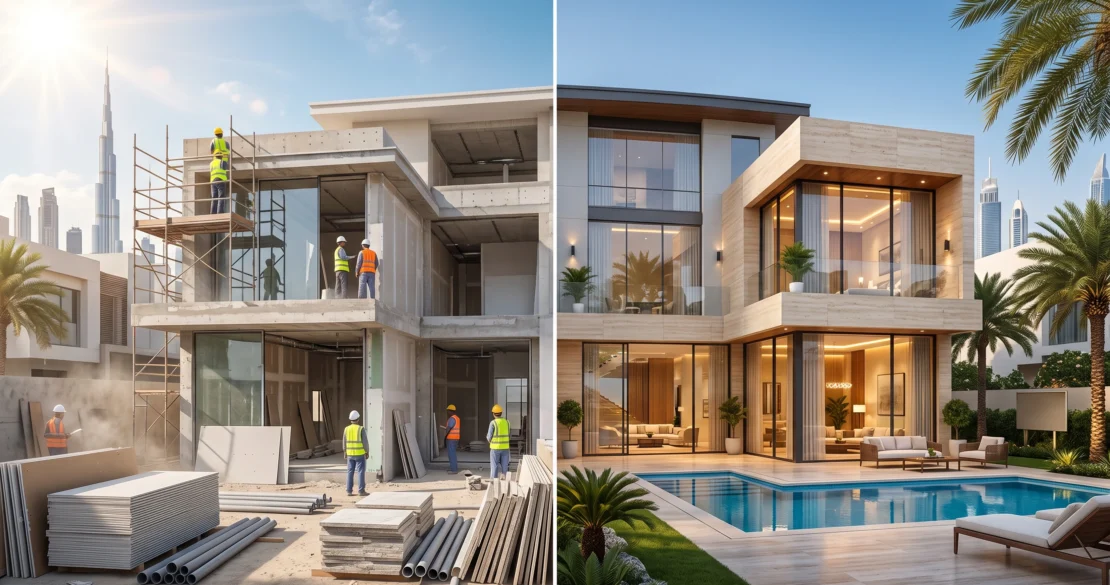
A modern Jumeirah beachfront villa using warm neutral exterior colors.
Warm white combined with sand and beige is one of the most versatile palettes for a beachfront villa.
Instead of using a very bright, cool white throughout the property, consider warmer shades such as ivory, cream or soft white. These colors help maintain a bright interior while creating a softer atmosphere.
Beige and sandy tones can then be introduced through furniture, flooring, curtains, rugs and decorative finishes.
This palette works especially well in:
- Living rooms
- Majlis areas
- Bedrooms
- Open-plan dining spaces
- Villa entrances
- Hallways
Natural wood can add another layer of warmth. Light oak, walnut or timber-look finishes can prevent a neutral interior from feeling flat.
The main advantage of this palette is its flexibility. You can change furniture and accessories over time without having to repaint the entire room.
2. Soft Blue, Ivory and Natural Stone
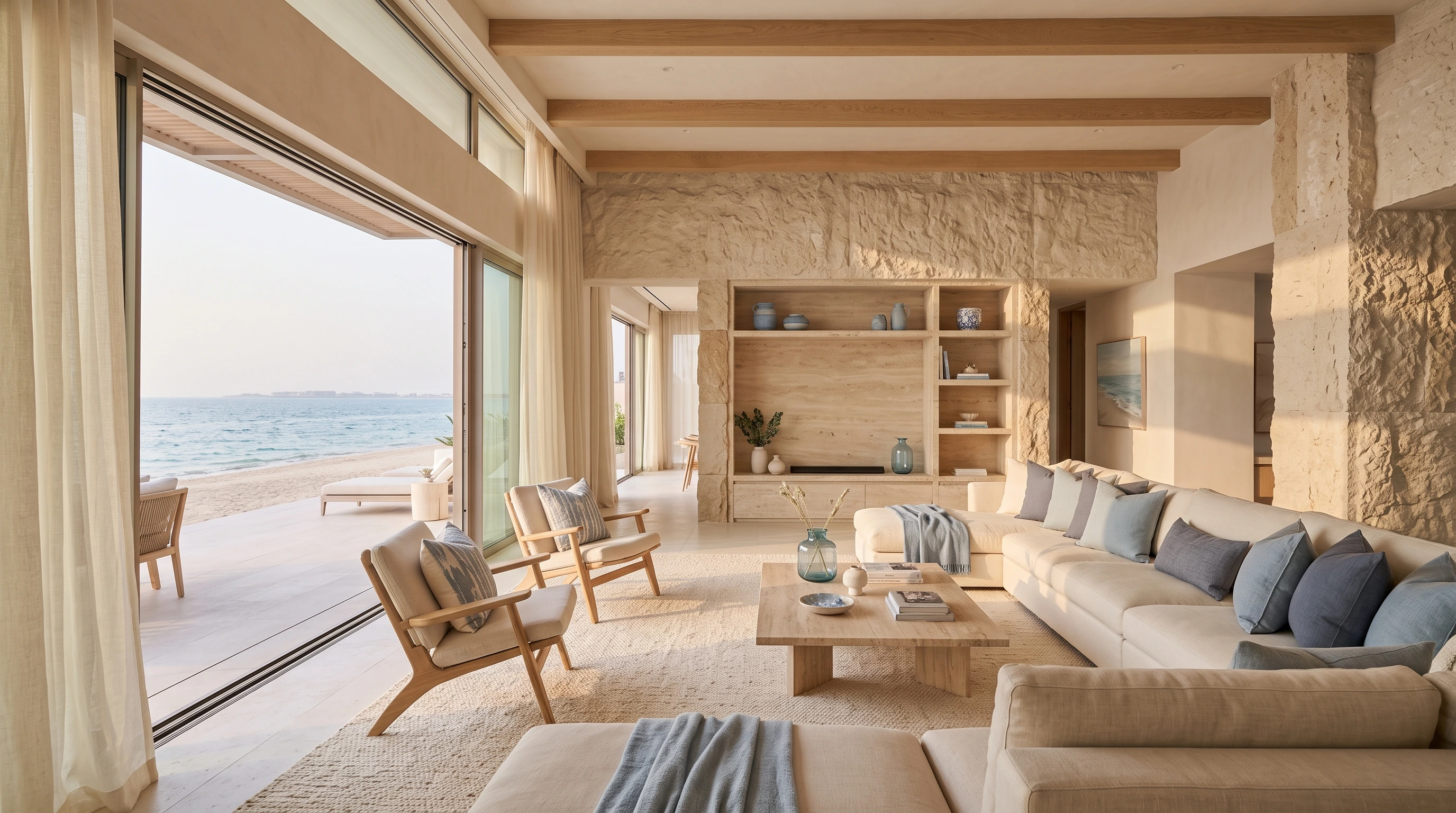
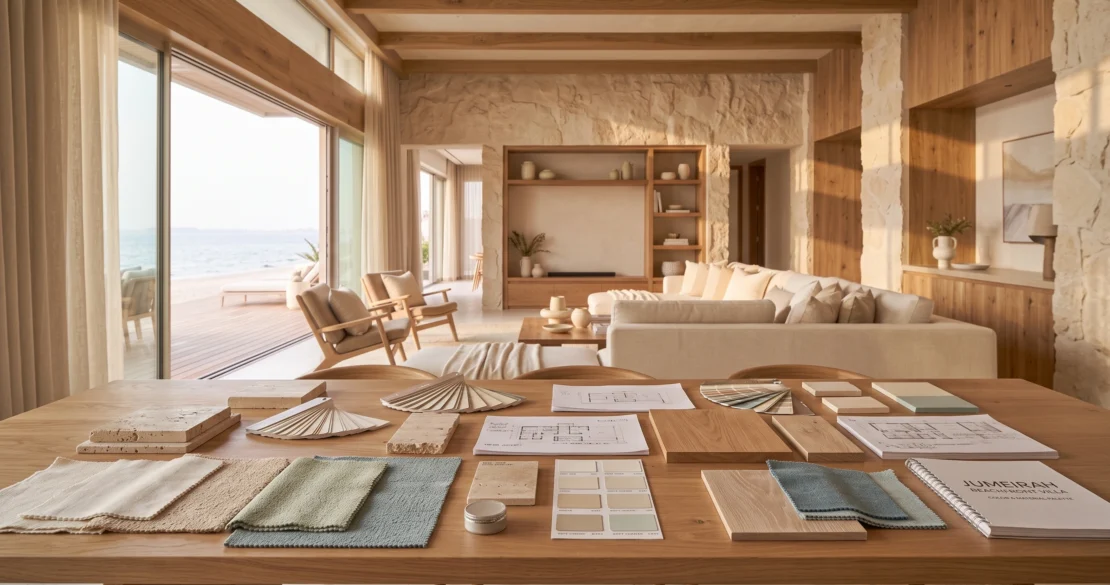
Warm neutrals and natural materials create a relaxed modern living space.
Blue is an obvious choice for a beachfront property, but it should be used carefully.
Instead of strong navy or bright turquoise across large areas, consider softer shades such as dusty blue, blue-grey or muted ocean blue.
Pair the blue with ivory walls and natural stone flooring or countertops. The result creates a subtle connection to the sea without making the villa look like a themed holiday home.
For example, you could use:
60% warm ivory
30% stone or beige
10% soft blue
The blue can appear through cushions, artwork, occasional chairs, rugs or one carefully selected feature wall.
This approach is particularly effective when the villa already has large windows overlooking the sea. The view provides the strongest blue element, while the interior simply complements it.
3. Greige, Cream and Charcoal
Greige combines the warmth of beige with the sophistication of grey. It is a useful option for homeowners who want a modern interior without using too much white.
A greige base can be combined with cream walls, charcoal details and natural materials.
Charcoal works particularly well for:
- Kitchen cabinetry
- Door frames
- Metal details
- TV walls
- Lighting fixtures
- Selected furniture
The key is moderation. A beachfront villa usually benefits from a lighter overall palette because of the amount of natural light.
Use charcoal as a contrast rather than covering an entire room with dark colors.
This palette is particularly suitable for contemporary villas with large areas of glass, clean architectural lines and minimal furniture.
4. Sage Green and Warm Wood
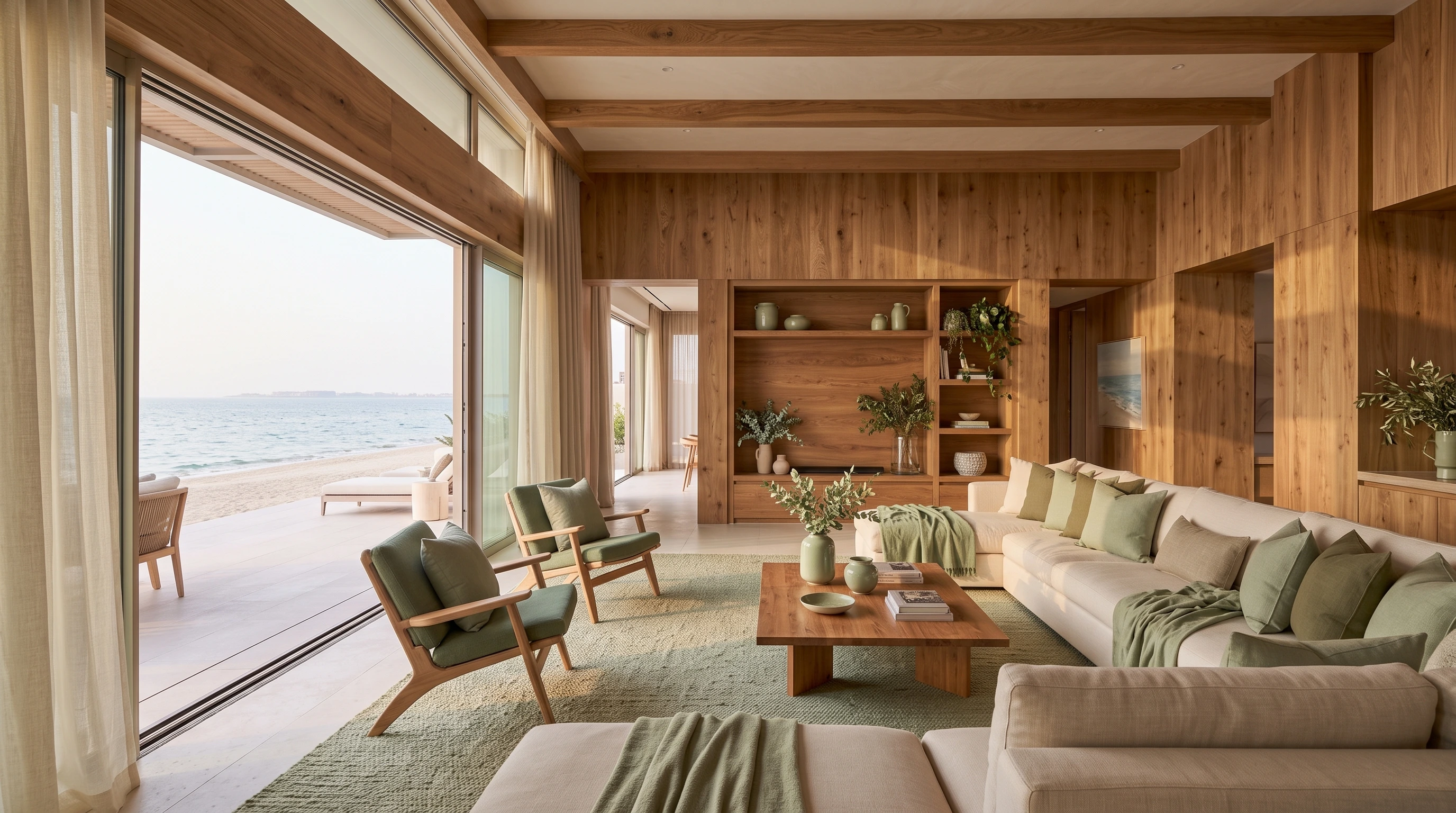
Muted green and natural wood create a calm and sophisticated villa interior.
Sage green is an excellent alternative to blue for a beachfront home.
A soft, muted green can bring a natural feeling into the interior without looking overly colorful. When combined with warm wood, cream and natural fabrics, it creates a calm and comfortable atmosphere.
Sage green works especially well in:
- Bedrooms
- Family rooms
- Reading areas
- Home offices
- Living rooms
You don’t necessarily need to paint an entire room green. A feature wall, built-in cabinet, upholstered chair or carefully selected accessories can provide enough color.
Plants can also reinforce the connection between the interior and the villa’s outdoor environment.
5. Cream, Terracotta and Sand
If you want something warmer, consider cream with terracotta and sandy tones.
Terracotta brings a subtle connection to natural earth and traditional Mediterranean architecture. It can work particularly well in Jumeirah because the area combines a coastal setting with Dubai’s warm desert environment.
Use terracotta selectively through:
- Decorative tiles
- Cushions
- Ceramic accessories
- Artwork
- Accent chairs
- Feature walls
A soft cream or warm white should remain the dominant color.
This prevents the terracotta from becoming too strong while still giving the interior personality.
6. Natural Stone, Warm White and Light Timber
Some of the most sophisticated villa interiors do not rely on many paint colors at all.
Instead, the design uses natural materials to create the palette.
Think about:
- Limestone
- Travertine
- Light timber
- Warm white plaster
- Beige stone
- Natural fabrics
The variation comes from texture rather than strong color contrast.
This approach works particularly well for homeowners who prefer quiet luxury and timeless interiors.
A modern beachfront villa can feel luxurious without using excessive gold, glossy finishes or strong colors.
The combination of stone and timber also creates a natural transition between the interior and outdoor areas.
7. Warm White, Olive and Brass
For a more elegant and slightly traditional villa interior, warm white can be paired with olive green and brass details.
Olive is deeper than sage but still has a natural quality. It works well as an accent color in furniture, cabinetry and decorative elements.
Brass can then be introduced through:
- Handles
- Pendant lights
- Mirrors
- Bathroom fittings
- Cabinet hardware
- Decorative accessories
Use brushed or aged brass rather than highly polished finishes if you want a more contemporary appearance.
This palette can work especially well in a majlis or formal living room where you want the interior to feel more distinctive.
8. Beige, Taupe and Muted Blue
Taupe is another useful neutral for modern villa interiors.
A combination of beige, taupe and muted blue creates a calm palette while providing more depth than a simple white-and-beige scheme.
For example:
- Beige walls
- Taupe sofa
- Light timber flooring
- Muted blue cushions
- Natural stone coffee table
The colors don’t need to match exactly. They simply need to share similar undertones.
This is important when combining several neutral colors. A warm beige can look uncomfortable next to a very cool grey, so test samples together before making a final decision.
9. Soft White, Charcoal and Natural Green
For a contemporary beachfront villa, soft white with charcoal and natural green can create a stronger architectural look.
Use soft white for the main background and introduce charcoal through doors, furniture or selected architectural elements.
Green can then soften the contrast.
Indoor plants, green upholstery and outdoor landscaping can all help connect the interior with the surrounding environment.
This palette is especially effective in villas with large windows because the greenery outside becomes part of the interior color scheme.
10. A Layered Neutral Palette
If you want a timeless option, keep the entire villa within a family of neutral colors.
You could combine:
- Warm white
- Ivory
- Cream
- Beige
- Sand
- Taupe
- Light brown
The challenge with an all-neutral interior is avoiding a flat or boring appearance.
The solution is texture.
Use different materials such as:
- Linen
- Timber
- Stone
- Glass
- Bouclé
- Textured plaster
- Woven fabrics
- Natural rugs
This creates visual depth without needing many strong colors.
For a luxury beachfront villa, this can be one of the most effective approaches because it allows the architecture and sea view to remain the main focus.
How Dubai’s Natural Light Affects Villa Colors
Color selection should always take the natural light of the property into account.
Dubai’s strong daylight can make some colors appear much brighter than they look indoors under artificial lighting.
A warm beige, for example, may appear almost cream in strong daylight. A cool grey can sometimes look much colder than expected.
This is why it is better to test paint samples directly on the villa’s walls.
Look at the color:
- In the morning
- Around midday
- In the late afternoon
- Under the property’s artificial lighting
This gives you a much more realistic idea of how the finished space will look.
The same principle applies to exterior colors.
Choosing Exterior Colors for a Jumeirah Beachfront Villa
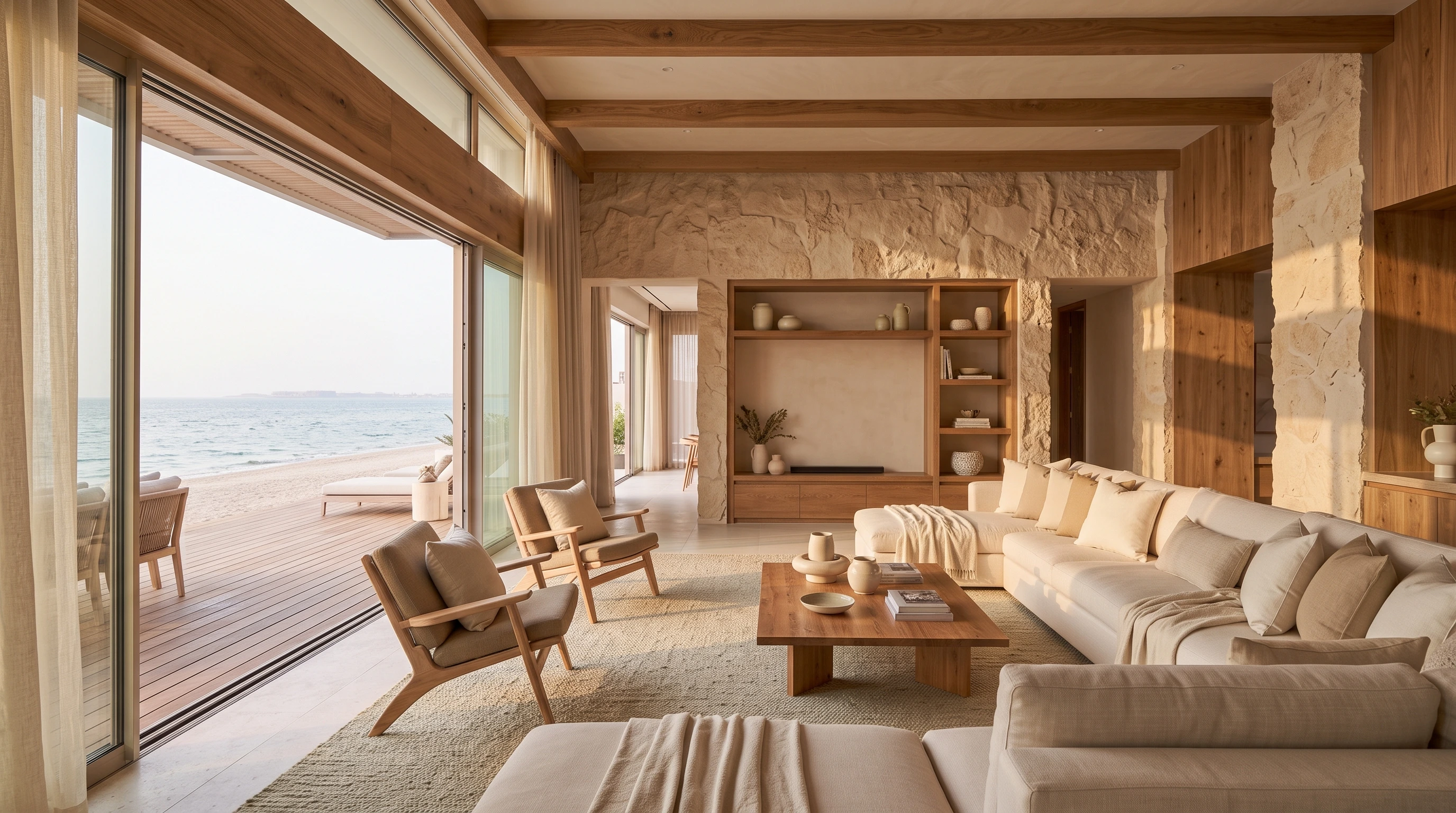
A layered neutral palette creates a timeless luxury villa interior.
The exterior palette deserves just as much attention as the interior.
A light neutral facade is generally a practical starting point for a modern villa. Warm white, sand, beige, stone grey and greige can work well with contemporary architecture.
Darker colors can be used for contrast around:
- Window frames
- Entrance doors
- Balconies
- Screens
- Architectural details
Natural stone can also introduce color without relying entirely on paint.
For beachfront properties, exterior material selection should also consider the local environment and maintenance requirements.
If renovation work involves changes to the facade or other building elements, check the relevant Dubai requirements before starting. Dubai Municipality’s Building Code sets minimum requirements for areas including building safety, welfare and environmental considerations, while its building permit procedures cover residential villas and related building work.
For more detailed information, refer to the official Dubai Building Code and Dubai Municipality Building Permit Procedures.
Should You Use Blue in Every Beachfront Villa?
No.
This is one of the biggest mistakes people make when designing coastal homes.
Because the property is beside the sea, it does not mean every room needs blue walls, blue furniture and blue accessories.
In fact, using too much blue can make the interior feel cold.
A better approach is to use the surrounding environment as inspiration rather than copying it directly.
For example:
Sea → muted blue accent
Sand → beige and cream
Sunlight → warm white
Natural landscape → sage or olive
Stone → taupe and grey
Timber → warm brown
This produces a more sophisticated coastal interior.
Match the Color Palette With the Flooring
Flooring is one of the largest visual surfaces in a villa, so it should be considered before finalizing the wall color.
If you have warm stone or wood flooring, warm whites, beige and cream usually work well.
If the flooring is cooler grey stone, you may prefer soft grey, greige or cooler neutral colors.
For a complete renovation, it is easier to coordinate flooring, walls, cabinetry and furniture as one scheme rather than selecting each element separately.
If your project involves a complete villa renovation, you can also review NCTechnical’s villa renovation services and related residential renovation projects when planning your design direction.
Use Color to Define Different Areas
An open-plan villa does not need to use exactly the same color everywhere.
Instead, use a consistent base palette and introduce subtle changes between spaces.
For example:
Living room: Warm white + beige + natural wood
Dining area: Warm white + taupe + brass
Master bedroom: Cream + sage + timber
Guest bedroom: Ivory + soft blue
Kitchen: Cream + stone + charcoal
Outdoor area: Sand + natural timber + greenery
Because the base colors remain related, the villa still feels cohesive.
Think About the Outdoor Areas
A beachfront villa is not only about its indoor rooms.
Terraces, balconies, pool decks and gardens are important parts of the overall living experience.
Choose outdoor colors that connect with the interior.
For example, if the interior uses warm white, beige and natural wood, continue those tones outside through stone flooring, outdoor furniture and timber details.
This creates a smoother transition between the villa and its surroundings.
Modern beachfront architecture increasingly treats terraces and outdoor areas as extensions of the interior, rather than separate spaces. Contemporary Dubai beachfront villa projects often use natural stone, warm timber and large glazing to create this connection between inside and outside.
How to Choose a Color Palette During a Villa Renovation
If you are renovating the entire villa, don’t choose colors room by room without an overall plan.
A better process is:
Step 1: Start With the Architecture
Look at the villa’s existing style, ceiling height, windows, flooring and architectural details.
Step 2: Select a Main Neutral
Choose one primary background color that can work across most rooms.
Step 3: Select One or Two Supporting Colors
These can be beige, taupe, sage, blue, olive or another complementary shade.
Step 4: Choose Materials
Select flooring, stone, timber, cabinetry and fabrics that work with your colors.
Step 5: Add Accent Colors
Use stronger colors through furniture, artwork, cushions, lighting and decorative elements.
Step 6: Test Everything Together
Do not approve colors based on separate samples.
Place paint, flooring, stone, fabric and cabinetry samples together to see whether the entire scheme works.
Common Color Mistakes to Avoid
Even an expensive villa renovation can look unbalanced if the color scheme is poorly planned.
Avoid these common mistakes:
Using too many colors:
A villa can become visually confusing when every room has a completely different palette.
Choosing colors from photographs alone:
Online images are affected by lighting, cameras and editing.
Ignoring undertones:
Two beige colors can look completely different if one has a yellow undertone and the other has a grey undertone.
Using too much dark color:
Dark accents can look excellent, but too much dark coverage can reduce the airy feeling that suits a beachfront villa.
Forgetting the exterior:
The facade, landscaping and outdoor areas should complement the interior.
Following trends too closely:
A villa renovation is a long-term investment. Choose a timeless base and use trends through easily replaceable accessories.
When Should You Work With a Professional Renovation Team?
If you are only repainting one bedroom, choosing colors yourself may be straightforward.
A complete villa renovation is different.
When walls, flooring, lighting, kitchen cabinetry, bathrooms, joinery and exterior areas are being changed together, the color palette needs to work across the entire project.
A professional renovation team can help coordinate:
- Color selection
- Material selection
- Lighting
- Flooring
- Joinery
- Kitchen finishes
- Bathroom finishes
- Wall treatments
- Exterior finishes
- Construction work
For a Dubai villa, it is also important to understand which renovation or modification works may require approvals. Dubai Municipality publishes requirements covering modification drawings, interior decoration works, maintenance permits, demolition works and other building-related matters.
For homeowners considering a complete renovation, NCTechnical’s construction and interior services in Dubai can be linked here as a relevant next step.
Frequently Asked Questions
What are the best color palettes for beachfront villas in Jumeirah?
Warm white, beige, sand, cream, natural wood, muted blue, sage green and taupe are strong choices. The best palette depends on the villa’s architecture, natural light, flooring, furniture and sea views.
Is blue a good color for a Jumeirah beachfront villa?
Yes, but it is usually better as an accent rather than the main color. Soft blue, blue-grey and muted ocean tones can complement the sea without making the interior look overly themed.
What colors make a beachfront villa look luxurious?
Warm white, cream, beige, natural stone, timber and carefully selected darker accents can create a sophisticated appearance. Luxury comes from the combination of color, materials, proportions, lighting and workmanship rather than color alone.
Should I use the same colors throughout the villa?
The colors do not need to be identical in every room. A consistent neutral base with different accent colors can create variety while keeping the villa visually connected.
Are dark colors suitable for beachfront villas?
Yes. Charcoal, olive, deep green and dark timber can create attractive contrast. However, they are usually more effective when used selectively rather than across large areas.
How can I make a beachfront villa feel more modern?
Start with a simple color palette, clean architectural lines and natural materials. Warm neutrals, large areas of glass, modern lighting, natural stone and carefully selected furniture can create a contemporary appearance.
Should the exterior and interior colors match?
They do not need to match exactly, but they should complement each other. Repeating related neutral and natural tones can create a smooth visual connection between the interior, facade and outdoor spaces.
What should I consider before choosing paint colors?
Consider natural light, existing flooring, furniture, ceiling height, window size, architectural style and outdoor views. Always test color samples in the actual villa before final approval.
Conclusion
The best color palettes for beachfront villas in Jumeirah are not necessarily the brightest or most obviously coastal. The strongest designs usually use a calm base and introduce character through natural materials, carefully selected accent colors and thoughtful lighting.
Warm white, beige, sand, taupe, natural timber, soft blue and muted green can all work beautifully when they are balanced with the villa’s architecture and surroundings.
Most importantly, choose colors based on the actual property rather than a trend or an online photograph. Dubai’s strong natural light can change how colors appear, while the villa’s flooring, windows, furniture and exterior materials will also influence the final result.
If you are planning a villa renovation in Jumeirah, color selection should be part of the wider design and renovation plan. Coordinating colors with flooring, lighting, joinery, bathrooms, kitchens and outdoor spaces will produce a much more consistent result.
Neon Craft Technical Services LLC provides construction, renovation and interior solutions in Dubai. If you are planning to modernise a beachfront villa, our team can help you develop a practical renovation approach that combines design, functionality and quality workmanship.